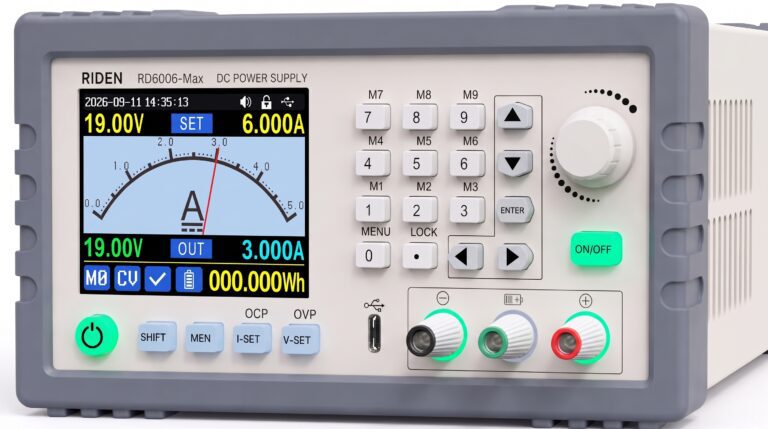
RD6006 vs RD6006-Max is a closer comparison than the model names suggest. The original RD6006 remains a capable bench supply, so a larger screen alone is not a reason to replace it.
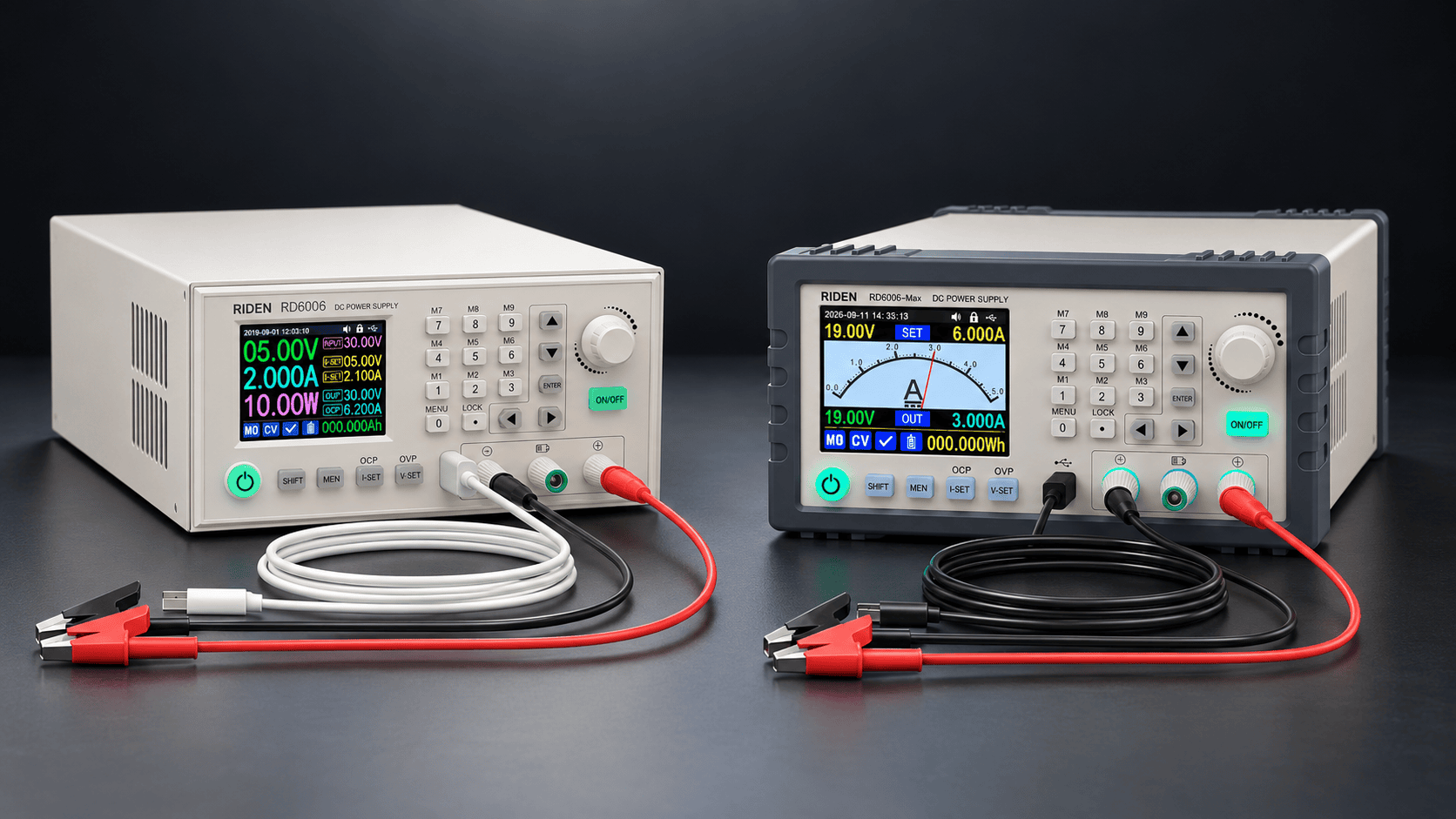
The RD6006-Max makes more sense once you look at a test in progress. Its new needle display gives you a way to follow changing current. When it is time to repeat a series of checks, the supply can run through the settings without a computer. It can also stop the output after a timed run, an input undervoltage event or an output short circuit. RIDEN has revised the filtering, sampling components and input protection as well.
Both models still reach 60V and 6A. So the buying question is straightforward: how much of the work around those settings would you like the supply to handle?
Both models still reach 60V and 6A. So the buying question is straightforward: how much of the work around those settings would you like the supply to handle?
When the current keeps moving
You have a probe in place and a board starting up. The current rises, drops, then rises again. You want to follow that pattern while keeping your hand where it is.
This is where the RD6006-Max’s new simulated current needle has a useful job. Movement across a dial gives a current change a direction you can follow. The digital display is still there when you want the numerical reading, and the curve view lets you follow the displayed history.
The screen grows from 2.4 inches to 3.2 inches, giving the operating information more room. The original RD6006 already offers digital and curve views; the needle gives you another way to follow changes during a test. For pulse duration and brief transient measurements, an oscilloscope remains the right instrument. The needle’s benefit is in following trends.
When you reach down to change leads, there is another visible difference. The output terminals now carry their own status lights:
This is where the RD6006-Max’s new simulated current needle has a useful job. Movement across a dial gives a current change a direction you can follow. The digital display is still there when you want the numerical reading, and the curve view lets you follow the displayed history.
The screen grows from 2.4 inches to 3.2 inches, giving the operating information more room. The original RD6006 already offers digital and curve views; the needle gives you another way to follow changes during a test. For pulse duration and brief transient measurements, an oscilloscope remains the right instrument. The needle’s benefit is in following trends.
When you reach down to change leads, there is another visible difference. The output terminals now carry their own status lights:
That puts the indication beside the connection you are handling. You do not have to move your attention back to the main display just to find that terminal’s status.
The front panel also gains Type-C communication in place of Micro-USB. Under the keypad, an immersion-gold finish improves the contact pads’ resistance to oxidation.
The front panel also gains Type-C communication in place of Micro-USB. Under the keypad, an immersion-gold finish improves the contact pads’ resistance to oxidation.
The next board is where List programming earns its place
The first board has finished its checks. Another one is ready, and it needs the same sequence of test conditions.
Suppose your procedure checks a module near the lower end of its specified input range, at its nominal input, then near the upper end. With the RD6006, saved presets make those settings easy to recall, but you still move between them yourself.
The RD6006-Max adds native 10-step List programming. You enter the voltage and current settings for the sequence, and the supply executes them in order. It runs directly on the device, without a PC connection.
A preset brings back one combination of settings. A List sequence carries out the progression. Once the same checks are being repeated across several boards, that difference becomes useful: your attention stays on the board’s behaviour while the supply changes settings.
For an existing RD6006 owner who does this kind of work, this is a concrete reason to upgrade. It changes a repeated task you already have.
Suppose your procedure checks a module near the lower end of its specified input range, at its nominal input, then near the upper end. With the RD6006, saved presets make those settings easy to recall, but you still move between them yourself.
The RD6006-Max adds native 10-step List programming. You enter the voltage and current settings for the sequence, and the supply executes them in order. It runs directly on the device, without a PC connection.
A preset brings back one combination of settings. A List sequence carries out the progression. Once the same checks are being repeated across several boards, that difference becomes useful: your attention stays on the board’s behaviour while the supply changes settings.
For an existing RD6006 owner who does this kind of work, this is a concrete reason to upgrade. It changes a repeated task you already have.
RD6006 vs RD6006-Max at a glance
| Feature | RD6006 | RD6006-Max |
|---|---|---|
| Screen | 2.4 inches | 3.2 inches |
| Current display | Digital and curve views | Adds a simulated needle view |
| Repeated test settings | User recalls saved presets | Adds native 10-step List sequences |
| Output terminal indication | No terminal status lighting | Yellow, red and green status lights |
| USB communication | Micro-USB | Type-C |
| Maximum output | 60V, 6A, 360W | 60V, 6A, 360W |
| Voltage and current setting steps | 10mV / 1mA | 10mV / 1mA |
| Timed output shutdown | No built-in output timer | Up to 99 h 59 min 59 s; output switches off at zero |
| Input undervoltage shutdown | No adjustable UVP function | Adjustable threshold and Undervoltage Delay; output switches off with a UVP message |
| Dedicated short-circuit shutdown | No dedicated SCP function | Output switches off immediately with an SCP message |
The original model’s ratings and display size are recorded in the RD6006 specifications. RD6006-Max details come from technical information RIDEN supplied directly to our store.
The screen and List function explain the changes you interact with. A longer test brings another part of the design into focus.
The screen and List function explain the changes you interact with. A longer test brings another part of the design into focus.
What matters once the supply warms up
You set the output, leave the test running and return to the readings later. By then, the power supply has warmed up. Keeping the reference and measurement circuits stable through that temperature change is a hardware job.
The RD6006-Max uses a precision voltage reference and voltage/current sampling resistors specified with a 25ppm temperature coefficient, together with zero-drift operational amplifiers in the sampling circuits. These components reduce temperature-related changes in the reference and measurement circuitry.
This helps explain why a supply’s setting resolution tells only part of the story. Both models use 10mV voltage steps and 1mA current steps. That tells you how finely a setting can be adjusted; stability also depends on what happens inside the supply while it is working.
The 25ppm figure belongs to the components’ temperature coefficient, rather than the accuracy of the complete instrument. Temperature coefficient and initial accuracy describe different properties.
Calibration addresses the voltage and current errors in the individual unit. It is part of the preparation we include with our assembled RD6006-Max before dispatch.
The RD6006-Max uses a precision voltage reference and voltage/current sampling resistors specified with a 25ppm temperature coefficient, together with zero-drift operational amplifiers in the sampling circuits. These components reduce temperature-related changes in the reference and measurement circuitry.
This helps explain why a supply’s setting resolution tells only part of the story. Both models use 10mV voltage steps and 1mA current steps. That tells you how finely a setting can be adjusted; stability also depends on what happens inside the supply while it is working.
The 25ppm figure belongs to the components’ temperature coefficient, rather than the accuracy of the complete instrument. Temperature coefficient and initial accuracy describe different properties.
Calibration addresses the voltage and current errors in the individual unit. It is part of the preparation we include with our assembled RD6006-Max before dispatch.
A steady voltage readout does not show the ripple
When a supply reads 5V, that number alone does not describe the noise riding on its DC output. For a noise-sensitive analogue circuit, that is part of the supply’s performance worth looking at.
RIDEN specifies output ripple of approximately 80mV for the RD6006-Max. It adds an LC filter at the output and a common-mode choke at the input.
The LC stage filters the voltage delivered to the load. The input choke reduces conducted interference between the front-end power supply and the regulator module. In other words, the design addresses interference arriving through the supply as well as filtering at the output.
These changes matter when you are choosing a complete bench supply. The adjustable module has a power source behind it, and the two work together. That same internal connection is also where the new input protection comes in.
RIDEN specifies output ripple of approximately 80mV for the RD6006-Max. It adds an LC filter at the output and a common-mode choke at the input.
The LC stage filters the voltage delivered to the load. The input choke reduces conducted interference between the front-end power supply and the regulator module. In other words, the design addresses interference arriving through the supply as well as filtering at the output.
These changes matter when you are choosing a complete bench supply. The adjustable module has a power source behind it, and the two work together. That same internal connection is also where the new input protection comes in.
What the 100V protection figure means
The original RD6006 is specified for a DC input up to 70V. The RD6006-Max adds hardware input overvoltage and reverse-polarity protection, with RIDEN specifying:
1. Tolerance of a 100V input overvoltage event lasting up to one second.
2. Protection against reversed input polarity at voltages up to 100V.
The 100V figure describes protection against an abnormal input event. It is not the normal operating input rating.
In an assembled unit, the module’s DC input connects to the internal AC-to-DC supply. The protection sits at that connection, inside the finished instrument. Output OVP and OCP still have their separate job at the load side. The new hardware addresses faults coming from the source feeding the module.
1. Tolerance of a 100V input overvoltage event lasting up to one second.
2. Protection against reversed input polarity at voltages up to 100V.
The 100V figure describes protection against an abnormal input event. It is not the normal operating input rating.
In an assembled unit, the module’s DC input connects to the internal AC-to-DC supply. The protection sits at that connection, inside the finished instrument. Output OVP and OCP still have their separate job at the load side. The new hardware addresses faults coming from the source feeding the module.
What happens when RD6006-Max stops the output
A protection label tells you very little unless you know what the supply does after the threshold is crossed. The RD6006-Max adds three automatic ways to end the output, each with a defined response.
Timed output shutdown
For a test that should run for a fixed period, the countdown can be set as high as 99 hours, 59 minutes and 59 seconds. When it reaches zero, the RD6006-Max switches the output off and the buzzer gives three short beeps.
Input undervoltage protection
After UVP is enabled, you set an input-voltage threshold, such as 50V. If the input drops below that threshold, the adjustable Undervoltage Delay countdown begins. This delay prevents a brief voltage dip from shutting the output off immediately. If the countdown reaches zero, the RD6006-Max switches the output off, shows UVP on the screen and gives three short beeps.
Output short-circuit protection
With SCP enabled, a short circuit at the output makes the RD6006-Max switch the output off immediately. The screen shows SCP, and the buzzer gives three short beeps.
UVP watches the source feeding the module; SCP watches the output connected to the load. In either case, the supply handles the shutdown automatically and leaves the cause visible on the screen.
UVP watches the source feeding the module; SCP watches the output connected to the load. In either case, the supply handles the shutdown automatically and leaves the cause visible on the screen.
Should a working RD6006 make way for it
If your supply spends most of its life at one setting, an RD6006 still has useful work to do. It already has keypad entry, a rotary encoder, saved settings and adjustable output overvoltage and overcurrent protection.
The upgrade makes a stronger case when you frequently watch changing current, repeat tests at several settings or need a test to stop without waiting for you to reach the output key. The larger screen, needle view, List sequences, timer, UVP and SCP then become things you use during the job. The filtering and low-drift sampling components add to the case for the newer design.
For a new purchase within the 60V, 6A range, we would choose the RD6006-Max. For a load that needs more than 6A, the next step is a higher-current assembled supply.
Whichever output range fits, there is one more choice that changes what happens when your order arrives.
The upgrade makes a stronger case when you frequently watch changing current, repeat tests at several settings or need a test to stop without waiting for you to reach the output key. The larger screen, needle view, List sequences, timer, UVP and SCP then become things you use during the job. The filtering and low-drift sampling components add to the case for the newer design.
For a new purchase within the 60V, 6A range, we would choose the RD6006-Max. For a load that needs more than 6A, the next step is a higher-current assembled supply.
Whichever output range fits, there is one more choice that changes what happens when your order arrives.
A module price leaves part of the job unfinished
A bare RD6006-Max module does not plug into the wall. It needs a suitable DC power source. Building it into a mains-powered bench supply also means dealing with the enclosure, mains wiring, earthing, cooling and final checks.
An assembly kit puts the parts in one order. The assembly is still yours to do. If you already have a suitable enclosure and power source, a module makes sense. If you want a complete instrument, the useful price comparison is for the whole setup, ready to run.
For a detailed breakdown of what comes with the module, supplier kit and finished instrument, see our RD6006-Max module vs assembled buying guide.
Our store sells assembled power supplies only. The RD6006-Max arrives with its enclosure, internal power supply and mains wiring already installed. Select the correct mains version and plug, connect it to the wall and start setting up your test.
Before dispatch, every assembled unit is load-tested and calibrated using our in-house Keithley DMM7510 multimeter. Assembly, testing and calibration are included in the unit you buy.
Pre-orders for our assembled RD6006-Max are now open. The first batch is scheduled to ship on October 15.
There is enough work waiting on a busy bench. Your new power supply can arrive ready for its share.
Pre-order the assembled RD6006-Max and choose your mains version.
An assembly kit puts the parts in one order. The assembly is still yours to do. If you already have a suitable enclosure and power source, a module makes sense. If you want a complete instrument, the useful price comparison is for the whole setup, ready to run.
For a detailed breakdown of what comes with the module, supplier kit and finished instrument, see our RD6006-Max module vs assembled buying guide.
Our store sells assembled power supplies only. The RD6006-Max arrives with its enclosure, internal power supply and mains wiring already installed. Select the correct mains version and plug, connect it to the wall and start setting up your test.
Before dispatch, every assembled unit is load-tested and calibrated using our in-house Keithley DMM7510 multimeter. Assembly, testing and calibration are included in the unit you buy.
Pre-orders for our assembled RD6006-Max are now open. The first batch is scheduled to ship on October 15.
There is enough work waiting on a busy bench. Your new power supply can arrive ready for its share.
Pre-order the assembled RD6006-Max and choose your mains version.
A few details before you choose
Does the RD6006-Max deliver more power than the RD6006
Both have a maximum output of 60V, 6A and 360W. At 12V and 6A, either delivers 72W; 360W is reached at 60V and 6A. A 12V load needing 10A therefore requires a higher-current model.
Does the assembled RD6006-Max support 120V mains power
We offer separate 120V and 230V versions, with US, EU, UK and AU plug options. Select the correct mains voltage and plug at checkout.
Do I need WiFi or a computer for List programming
No. The 10-step List function runs on the RD6006-Max itself. WiFi is an optional add-on for wireless control. The Type-C port supports communication with the Windows control software.