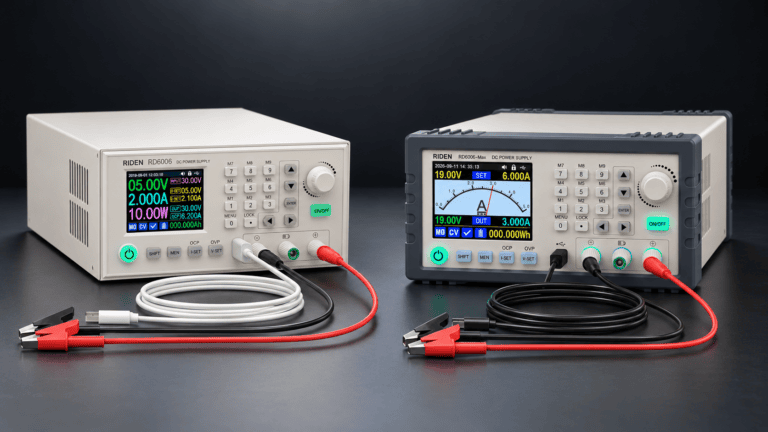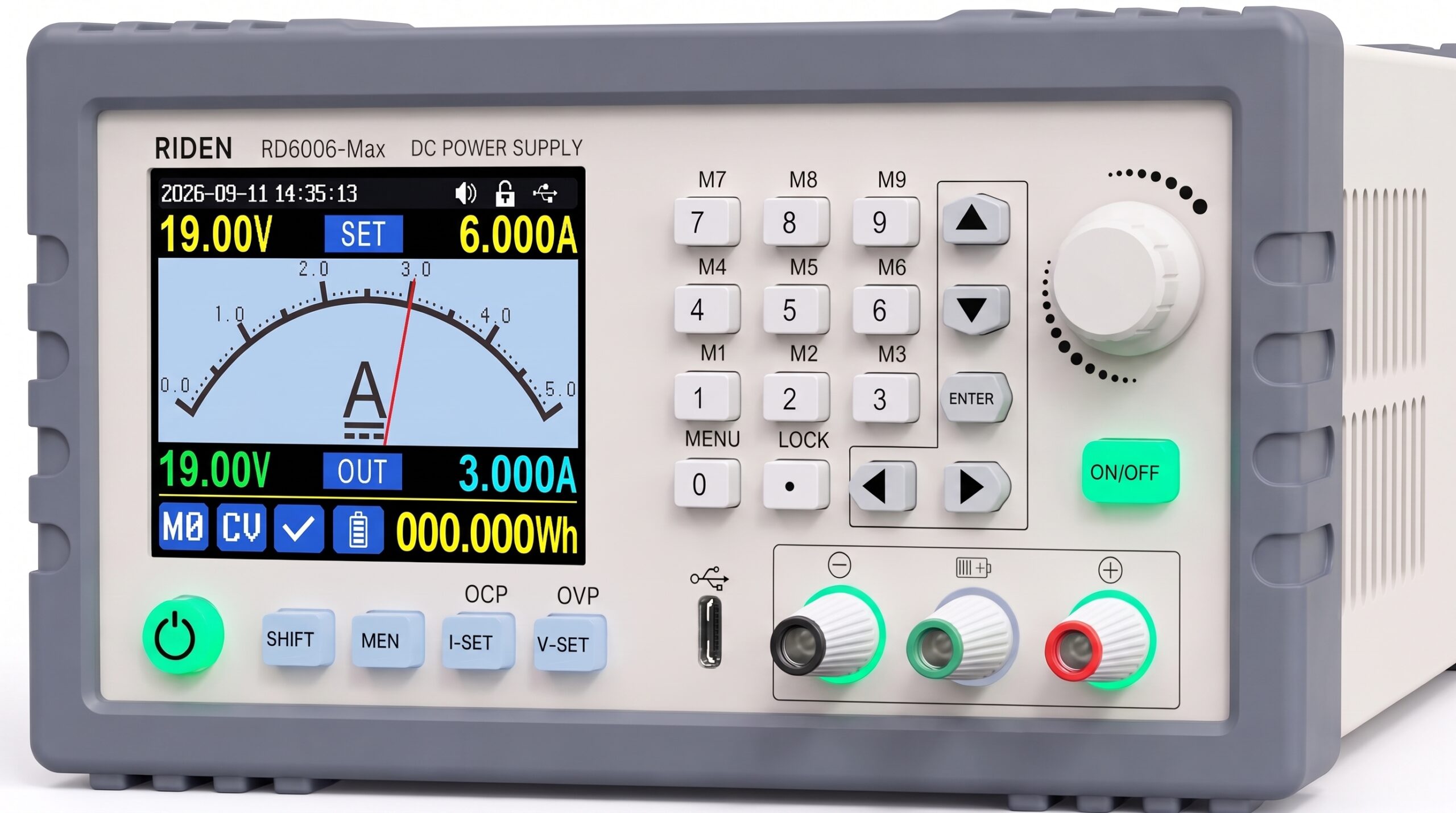
This guide explains what arrives in each format and what remains to be done after delivery. For the changes inside the new model, including the display, filtering, input protection, automatic shutdown functions and List programming, read our separate RD6006 vs RD6006-Max technical comparison.
What arrives in each RD6006-Max version
| Purchase format | What arrives | What still needs to happen |
|---|---|---|
| Bare module | RD6006-Max control, display and regulation module | Add a suitable front-end power supply, enclosure, mains hardware, wiring, protective earth, cooling and final checks |
| Supplier DIY kit | Module, enclosure, 230V-to-68V front-end supply, power cable and silicone cover | Assemble and wire the unit, complete grounding and cooling, then inspect and test the finished build |
| Fully assembled unit | Complete enclosure, internal power supply, mains wiring, cooling and front-panel module | Select the correct mains voltage and plug, connect the load and begin work |
A bare module leaves a complete power path to build
The remaining work includes the mains inlet, fuse and switch, protective earthing for a metal chassis, internal AC and DC wiring, terminal connections and airflow. The finished build then needs inspection before power-up, followed by functional and load checks.
None of this makes the module a poor product. It makes the module a component for someone who wants to design or integrate the rest of the instrument. If you already have a suitable enclosure and power source, or the build itself is part of the hobby, that flexibility is useful.
If the goal is to add a working power supply to a repair bench, the unfinished work belongs in the price comparison.
The DIY kit shortens the shopping list
The kit still arrives as an assembly job. The buyer installs the components, completes the internal wiring and grounding, checks the cooling arrangement and verifies the finished unit.
The listed front-end supply also deserves attention in countries that use 120V mains. A kit built around a 230V supply should not be assumed to support a US wall outlet. Check the exact mains version included before ordering.
For someone who enjoys building test equipment, the kit offers a more direct route than sourcing every part separately. For a business or a busy repair bench, it still turns a power-supply purchase into a project.
What our assembled RD6006-Max includes
We stock separate 120V and 230V versions, with US, EU, UK and AU plug options. The voltage selection determines the internal power supply, while the plug selection determines the supplied mains cable. This is more than changing the cable attached to the same internal unit.
After assembly, every unit receives a load test. We then calibrate its voltage and current through the supported software using our in-house Keithley DMM7510 7.5-digit multimeter as the reference.
The component specifications describe the design. Calibration addresses the voltage and current errors in the individual finished unit. The two steps serve different purposes, which is why our preparation includes both load testing and calibration.
The result is a power supply that can go onto the bench, connect to the correct wall outlet and begin work without a separate assembly session.
Pre-order the assembled RD6006-Max and choose your mains version.
Compare the cost of a working instrument
2. Enclosure and mounting hardware.
3. Mains inlet, fuse, switch and power cable.
4. Output terminals, internal wiring and protective earthing.
5. Cooling parts and assembly materials.
6. Time for assembly, inspection and fault finding.
7. Access to a suitable load and reference meter for checking the result.
Time carries a different value for every buyer. A weekend build can be part of the enjoyment for a hobbyist. The same hours can interrupt billable repair work or delay a laboratory setup.
Which RD6006-Max format fits your work
Choose the bare module for integration
Choose the DIY kit when the build is part of the purchase
Choose the assembled unit when the supply is a tool
Three shutdown settings to configure for the job
If the input source can sag, enable UVP and choose an input-voltage threshold. When the input falls below it, the adjustable Undervoltage Delay countdown begins, avoiding an immediate shutdown during a brief dip. If the countdown reaches zero, the output switches off, the screen shows UVP and the buzzer gives three short beeps.
When a detected short circuit must end the test immediately, enable SCP. A short at the output switches the output off at once, shows SCP on the screen and produces three short beeps.
RD6006-Max pre-orders and first-batch shipping
Pre-order the assembled RD6006-Max.
Frequently Asked Questions
No. The module requires a suitable DC input from a separate front-end power supply. A mains-powered build also needs an enclosure, fused mains inlet, switch, wiring, protective earth and cooling.
No. The DIY kit supplies the main parts, but the buyer completes the assembly, internal wiring, grounding and final checks. An assembled unit arrives with those tasks completed.
Yes. We offer separate 120V and 230V assembled versions with US, EU, UK and AU plug options. Select both the mains voltage and plug used in your region at checkout.
WiFi is optional. The RD6006-Max works from the front panel without it, and the Type-C port supports wired communication with the Windows software.
No. The 10-step List function runs on the RD6006-Max itself. A computer or WiFi connection is not required to execute the sequence.
We use a Keithley DMM7510 to reference the voltage and current of each finished assembled unit, then correct the unit through the supported software. This addresses unit-level output and measurement error after assembly. Load testing is performed separately.
Our RD6006 vs RD6006-Max comparison covers the display, Type-C port, terminal lights, filtering, low-drift components, input protection, timed shutdown, UVP, SCP, current needle and native List programming.